
Are you too old to ride a motorcycle?
by Corn Dog on July 27, 2017
in Commentary
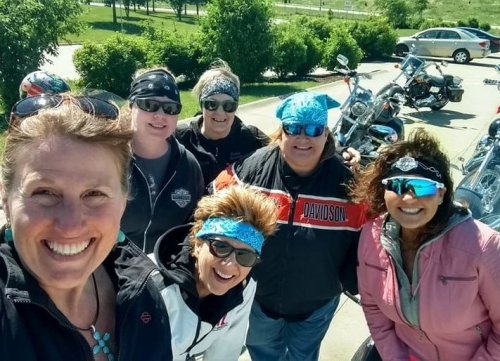
In our 40’s, 50’s and 60’s – and not one of us is too old to learn! (Photo by Janet Stoll, aka “Seven Over”)
Am I too old to learn to ride? How old is too old?
If you’re in your 20’s or 30’s, you probably aren’t worried about these questions in the slightest. (In fact, if recent industry news reports are to be believed, you aren’t even thinking about riding. What’s up with that?) But if you’re in your mid-life and contemplating riding a motorcycle, this may actually be one of the first questions you ask yourself.
My view is, that while age itself is just a number and pretty much immaterial, it is actually the bodily aging we eventually experience that you should be evaluating when you consider the question of “how old is too old.”
In my e-book, GET ON: A Guide to Riding Motorcycles for Women Who Think Too Much, this message alludes to aging:
Are you physically capable? You don’t have to be an athlete to ride a motorcycle – I am living proof of that… But you can’t be physically frail – you must have confidence that you’ll be able to raise the bike off the kickstand and maneuver it around.
This doesn’t speak to your age, per se. Rather it speaks to your physical suitability for operating and controlling a bike. So instead of thinking about your age (50? 65? 76?), think about your aging: How are your vision and hearing? Your reaction times? Your upper body strength? Your knees, hips and ankles? The steadiness of your gait? Your quick-thinking capabilities? Your general ability to quickly absorb and learn new tasks?
Of course, your physical limitations – whether or not they are related to aging – don’t necessarily preclude you from riding if you have the determination to work through them. I know of one woman who suffers from chronic fibromyalgia and rides thousands of miles a year, in spite of the discomfort it creates. Another who lost her leg in an accident and still rides with a prosthetic. When you have physical limitations, you should seek out other riders who battle the same limitations – chances are you’ll be surprised at the types of “issues” people ride with, and the ways in which they’ve managed to cope with those issues.
Another consideration is the notion of risk vs. reward. I’d be willing to bet that every person who rides answers this question for themselves, over and over again throughout their lifetime whether they are conscious of it or not. Do the rewards of riding outweigh the risks? The answer to this question can definitely change as we age. Think about the “risks of riding” in relationship to these statements:
- I’ve just been blessed with my first grandchild!
- My diabetes is making my foot numb.
- I haven’t had the same zeal since the heart attack three years ago.
- I’ve been riding for 25 years with no accidents – maybe that’s enough adventure.
I have a friend who is in her late 60’s. After a medical issue was discovered, her doctor told her “You can ride, but if you do anything to injure your spleen you’ll bleed to death before help can get to you.” She has been riding for more than 12 years with never so much as a bike drop. She’s not “too old to ride,” but she has re-considered the risk vs. the reward and decided she’s done with motorcycles.
Ultimately, the question of whether you’re “too old to ride” is one you’ll have to answer for yourself. But remember, there’s no magic cut-off number. Whether you are too old has far more to do with the impact of aging than with actual age.
After all, I’m pretty sure Rochelle Simms didn’t give a rip about being 91 when she took a ride last month on a Suzuki GSX-R1000 superbike:
Twit-storm of tweeted tweets
by Corn Dog on July 18, 2017
in Commentary
It’s feast-or-famine over on Twitter for me… when I get busy, it’s the first social media platform I abandon. But I do find a lot of cool stuff there whenever I am active, and of course I have to always add my “.02” to everything I read… follow me if you like at Twitter.com/BikerChickNews!
Here’s a brief look at what I’ve been doing over there recently:
Sharing tales of epic journeys:
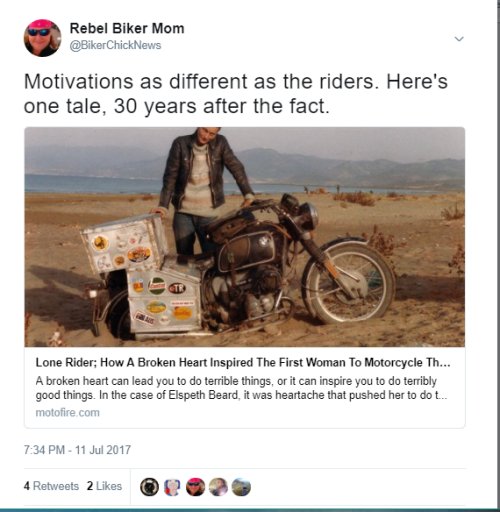
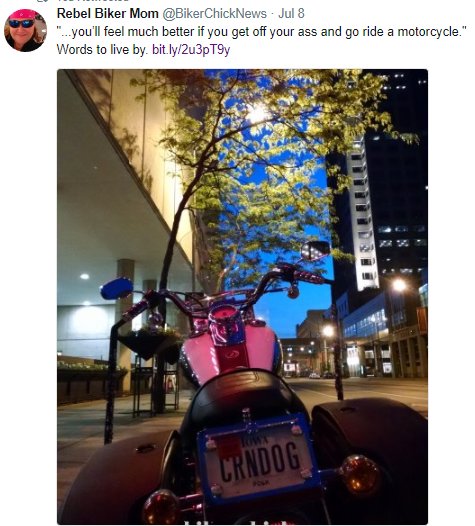
Providing motivational encouragement…
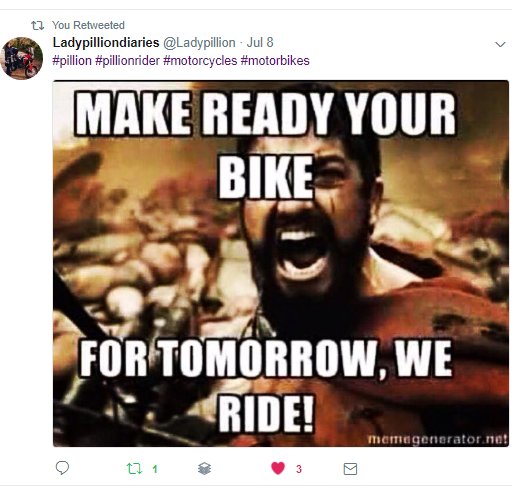
Rallying the troops…
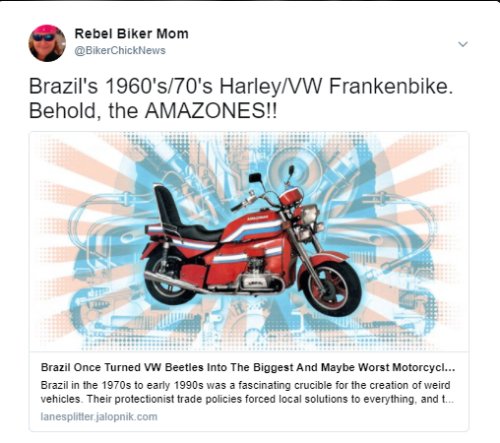
Exploring ancient motorcycling history…
Airing my dirty laundry…
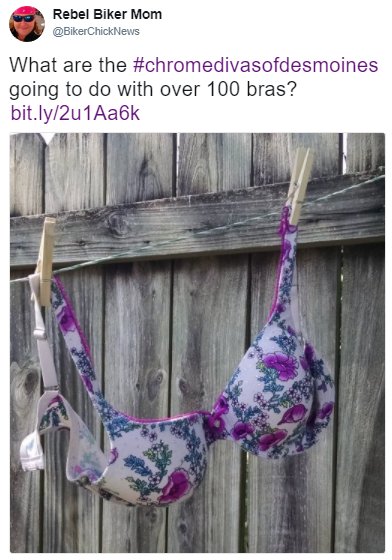
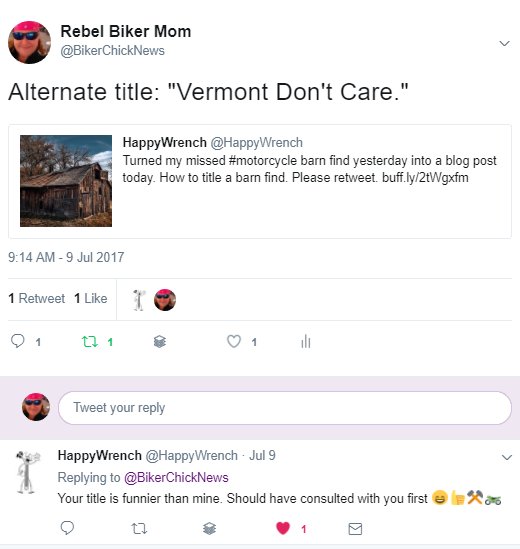
Helping fellow bloggers fine-tune their work…
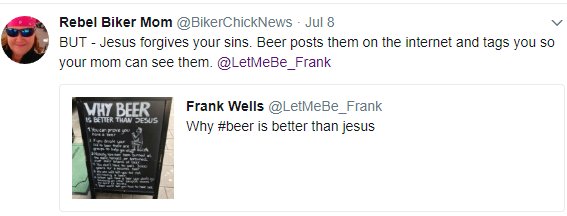
Debating the pros and cons…
… and of course just generally having fun!
Maybe I’ll see you over there!
Yes I still ride… excuses, plus events!
by Corn Dog on May 10, 2017
in Commentary
Okay okay, yes it’s been since February (FEBRUARY, people!) since I last updated my blog… but I can assure you, I’m still here and I do still ride.
In fact I have ridden nearly TWO TIMES already this season. Nearly two! Okay so that’s really only one, but that is nearly two so technically the previous statement is correct. You see, I have kind of lost my riding mojo over the last couple of years… never really sure I want to get started at the beginning of the season, coming to a point where I don’t really care whether I ride again… and then finally taking that first ride and realizing, yes, I still love this.
Now in my defense, I didn’t go to the motorcycle swap meet because of my pissy attitude but also because normally the swap meet is kind of a turning point for me in the non-riding season where I can see that Spring is just around the corner. But this year, winter was really mild – we never even had one snow where I had to use the shovel – not one! And certainly not “nearly two”! So I was just sort of “meh” on the swap meet this year. I’m sure it was great, because it is motorcycle parts and a custom bike show – what’s not to love??
Then March was full of cold and rain, and then in April I did take my first ride but then the Bike Blessing at Big Barn was rained out (cancelled, even!) toward the end of the month and that meant our Chrome Divas ride was also a bust. Last weekend was nice, but I was doing other things… but… but… THIS weekend looks like it’s also going to be nice, so I will be headed out. Where, exactly, I have no idea but… I’m going!
Also, I have an appointment on Saturday morning that hopefully will result in something really fun – so stay tuned, I’ll report on that ASAP!
I did take what qualifies as the “first ride of the season” not too long ago… I did a southerly loop from my home in West Des Moines down Highway 28 to 92, then west to Indianola and back up my old favorite, R63. I have to be honest: the only thing I could think of at first was really morbid “what if I crash”-type stuff. But by the time I got home, my mind was right and I had had a few miles of fun.
All this said, I’m blaming the lack of a horrible Winter for the sense of non-urgency I feel about riding this Spring, and I will soon be out and about. Here are a few upcoming events in the area… not saying I’ll be there, but if YOU want to go, here they are:
May 13 – 22nd Annual Blessing of the Bikes sponsored by F&J Racing of Marshalltown, 2-4 pm.
May 19 – Indianola Bike Night, 5-10 pm on the Square in Indianola.
May 20 – Rescheduled Blessing of the Bikes at Big Barn Harley Davidson, with Christian Motorcycle Association and ABATE of Iowa, beginning at 10 am.
May 21 – ABATE of Iowa Thunder Ride to honor Vietnam Veterans, leaves at 11 am from Southridge Mall parking lot, goes to the Vietnam Memorial at the State Capitol.
There’s way more than this, of course… Indianola Bike Night, 2nd Avenue Bike Night, bike nights in just about every town around… see a more complete list on the Facebook page for Thunder Roads Iowa!
Okay now you are up to date… more soon, for real!
A message from Janis
by Corn Dog on October 4, 2016
in Commentary
October 3, 2016 marks the 10th anniversary of the publication of this post from my original blog (long since dissolved into the internet ethos), “A Blogger Looks at Forty.” I have updated the math in the dates referenced near the end of the piece; the rest remains unchanged from the original post. Thanks for reading about these two crazy, special women.
Why did Janis Joplin call me today?
While dressing for work I decided to take a few CD’s with me, and Janis’s “Greatest Hits” was one I happened to grab. At work, as I popped it into the computer to play, I studied the photo used for the cover art. It’s Janis in a red peasant blouse, a slug of bracelets on her wrist and beads around her neck, perched on a motorcycle and staring out with a grin through those big round glasses.
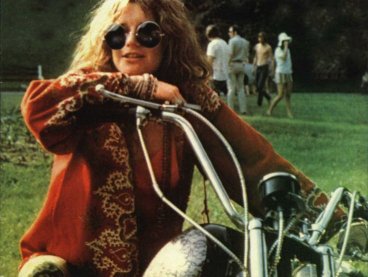 I’m feeling an odd connection to her since I started riding my Harley, but it’s not because I identify much with her music or her lifestyle. (I can’t get enough of her “Me and Bobby McGee” recording, which was released posthumously, but I can’t say I’ve been a lifelong fan. And the drug culture she embraced – well that’s just not my thing and never has been.) I think it’s just that she embodies the freedom of spirit I feel when I’m on the bike – even though the music itself doesn’t speak to me that strongly, her sense of self and the outward expression of it certainly do.
As I stare at Janis’s photo, I take in her look. It’s a strong, rebellious statement, one I am too straight-laced to mimic or adapt. She has, however, always kind of reminded me of my sister – from her general appearance to her hard-partying lifestyle and, ultimately, her untimely drug-related death. The photo of Janis on the motorcycle in 1970 could easily have been my sister Kathy in 1980. (Kathy rode pillion her entire life. I like to think she would’ve followed my example and learned to ride her own eventually, though it would have bugged the crap out of her that I’d thought of it first.)
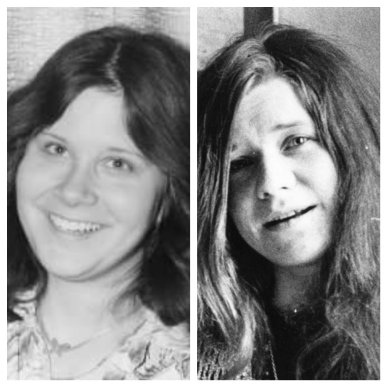 I look up a few more images of Janis on Google, continually struck by how much she looks like Kathy and still trying to figure out why I’m suddenly so interested. I visit the official legacy website managed by Janis’s family, follow a couple links, and read a chronology of her life events. And a date pops out at me. October 4, 1970: the date that Janis died, at 1:40 in the morning, from a heroin overdose. It occurs to me that that is tomorrow’s date. Is that why I thought to grab Janis’s CD this morning, because for some reason I am supposed to mark that occasion?
I glance back at the photo and this time the resemblance to Kathy is almost over-whelming. And I realize: if tomorrow is October 4, that means today is October 3. And October 3 is the day Kathy was born.
And so, while not a week has gone by since Kathy’s death from cocaine overdose that I haven’t thought of her, it occurs to me that perhaps Janis called me today to make sure I didn’t forget my sister on her birthday. So while I’m taking a moment to acknowledge Kathy’s short, tumultuous life, I’ll also give a nod to her famous sister-in-spirit. I’ll reflect for just a moment on the fact that 46 years ago today, a kid named Kathy was celebrating her 10th birthday and a singer named Janis was living her last day on Earth. And both were probably thinking that forever still stretched ahead.
Riding rocks, but so does WIND THERAPY!
by Corn Dog on July 26, 2016
in Commentary
Note: Leslie Cook, who created the Wind Therapy line of hair and skin-care products, recently sent me samples of her products for my honest opinion about their use and effectiveness. Below are my thoughts!
Between the street in front of my house being closed for reconstruction since June 9 (JUST re-opened a couple weeks ago!) and temperatures in the mid-to-upper 90’s the past few weeks, I haven’t done much riding since early June. BUT – I did finally get to venture out with the Chrome Divas on Saturday the 23rd. More about that soon!
What I really want to tell you about is that I finally got an opportunity to give a “fair trial” to some new personal care products for women who ride.
Maybe you have already heard about “Wind Therapy” – a new line of skin and hair care products from rider Leslie Cook. If you haven’t tried them, I hope you will! Leslie was kind enough to send me some samples recently, and I promised I would provide you-all with a recap of my experiences using them. I felt a little funny doing that, however, knowing I wouldn’t be trying them on a motorcycle ride – the very activity they’re designed to improve. So while I’ve had the products for a few weeks, I finally was able to try them over the weekend.
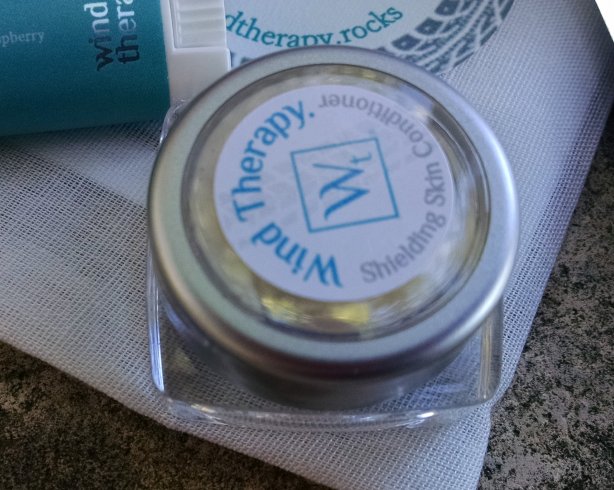
The product samples I received were Wind Therapy Shielding Lip Conditioner, Shielding Skin Conditioner, and Shielding Detangler. I used all three as directed, during and after my ride on Saturday the 23rd.
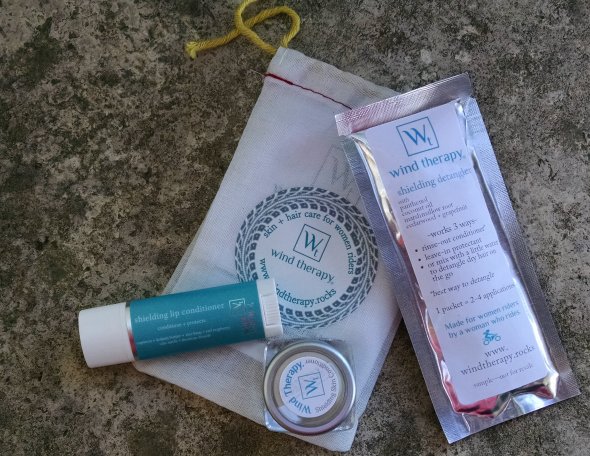
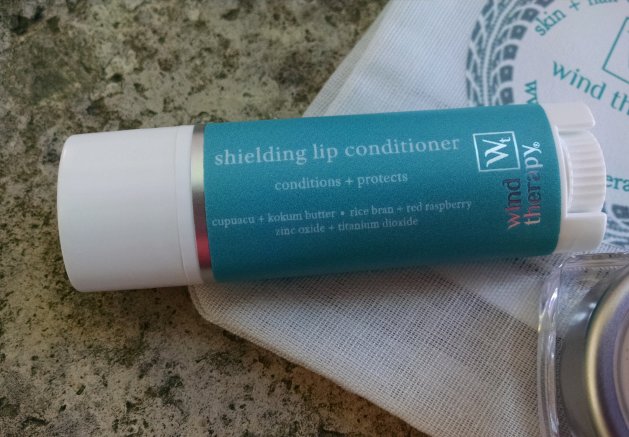
Shielding Lip Conditioner – I have a love/hate relationship with lip balm. It is the one thing I almost always forget to take with me, and begin to miss it after about 60 miles on the bike. So I usually end up buying some at a convenience store, and as a result I have probably ten of them floating around the house at any given time. My product of choice has always been Chapstick. What I dislike about Chapstick is how thick it feels once applied, and how “goopy” it gets after being on my lips for some time. Wind Therapy Shielding Lip Conditioner does not have these issues. It feels like a thin, sheer layer on my lips, and feels the same after a 90-mile ride as it does when first applied. It has no flavor or scent. When I use it overnight, it works continuously to keep my lips hydrated and soft.
Shielding Skin Conditioner – My normal routine when prepping for a ride is to apply a large helping of moisturizing lotion to my arms and face, followed up with a heaping helping of sun block. The main problem I have with this method is that these exposed areas feel like they are covered with sludge by the time I get home – a layer of dirt and dust sticks to me precisely because of these products. What I appreciated about the Wind Therapy Shielding Skin Conditioner was that it seemed to alleviate this problem. It kept my skin hydrated, without the heavy feeling of a thick layer of lotion. It felt light and non-greasy when I applied it to my arms and face, and my usual layer of sunblock therefore also felt lighter because it didn’t have the thick undercoat.
This product also has a light fragrance, but I must confess I did not care for it – it seems too “mediciney,” more like a medicated lotion such as Sarna. (This complaint was alleviated once I put on my tropical-scented sunblock.) I did like the “weight” of the product on my skin, though – it seemed to literally disappear when I put it on, rather than feeling like a thick layer – as well as the job it did protecting my skin from drying out.
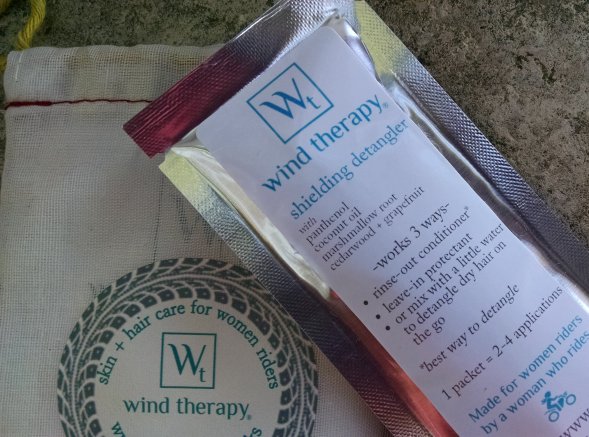
Shielding Detangler – This is the product I assumed I would need the least. I keep my hair fairly short, and I wear a helmet when riding. So, honestly, tangles are not really a problem for me on the road. (More about how I used it in a moment.) I will say, that what’s unique about this product is that one of its uses is as a detangler during a ride. To do this, you simply wet your hands and work the detangler into your hair. There is no need to immediately rinse it out – you can leave it in your hair.
While I didn’t try the product in this way, I did give it a try as part of my usual hair care routine: I simply used it as a conditioner after shampooing my hair in the shower. My routine here is to first shampoo, then use conditioner, all of which of course I rinse out. Out of the shower, I pat my hair with a towel so it’s not dripping wet, then comb it out. In this use, I was really surprised at how easily I was able to pull the comb through my hair – usually tangles remain, but with this product, they did not. Once fully dry, my hair had a soft and smooth texture that was nice, but I feared would prevent it from holding my usual style. I’m happy to report this wasn’t the case – my hair held its style with no problems. And, it worked better at removing the post-shower tangles than other conditioners I’ve tried!
Overall, while I know there are others who can give the Wind Therapy products a more rigorous trial, all the products I tried were more effective than the brands I currently use and felt “lighter” on my skin and hair. I absolutely loved them and appreciated the chance to try them out!
Please connect with Leslie on Facebook, and through the Wind Therapy website at www.windtherapy.rocks!
A moment to reflect
by Corn Dog on May 30, 2016
in Commentary
“Today we honor those who made the ultimate sacrifice. May God bless the souls of those who died defending our liberty.” – Senator Marco Rubio
Hope you have many moments today to pause and reflect upon the sacrifices made for us by those who gave their lives serving America and defending our freedom around the world.

Do you have sufficient arrogance?
by Corn Dog on May 20, 2016
in Commentary
Do you have sufficient arrogance?
I don’t mean to ask, “Do you think you’re better than everyone else?” What I mean is, do you know just how knowledgable you really are, and do you believe in the value of what you know?
Speaking from a business perspective, marketing blogger Scott Hartshorn years ago made the point that it’s easy to assume that other people in your industry are better or smarter than you, and therefore more credible. And this assumption can keep you from putting yourself out there, getting known, taking risks, and reaping the rewards.
I believe that this notion can be applied across the board: not just to Scott’s industry of commercial blogging, but to work, family, parenting, hobbies, socializing and even community involvement.
More recently, moto-blogger Rachael (Fuzzygalore.com) noted that for many of us, there are two yous: Your You and Someone Else’s You. And, that Someone Else’s You is almost always “bigger and bolder” than Your You.
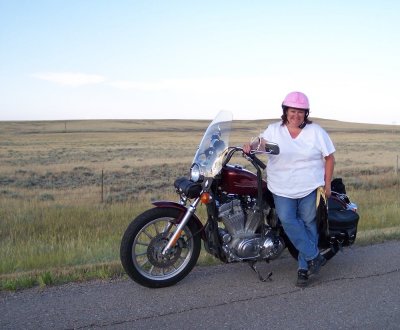 I think Scott & Rachael are saying the same thing – though in different words and from two different life perspectives: that we hold ourselves back from our true potential because we just don’t think our experience and knowledge are as valuable as that of others. We believe, for whatever reason, that outsiders are the experts while we are just… us.
Having been a business owner, a Chamber of Commerce leader, the “new gal” for various employers, a first-time parent, a newbie motorcycle rider, and even a newbie blogger at various points in my life, I can relate to this concept of “insufficient arrogance” on many levels. So many times, I’ve realized (perhaps too late) that I didn’t start out a new phase of my life or a project with the belief that what I brought to the table was just as good, if not better, than what other folks brought.
In short, I’m not sufficiently arrogant!
Or to put it in Rachael’s terms, My Me is standing in the way.
Is this because I’m too dependent on the approval of others? On the notion of being liked? On the idea that what I know is somehow less valid than what others know? Am I – inconceivably – allowing the hard-won knowledge I’ve gained and the experiences I’ve had in life to hold me back me rather than propel me?
And the questions too painful to ponder: What has my insufficient arrogance cost me? What opportunities have I missed because My Me did not measure up? Am I not yet who I wish to be simply because I didn’t think I was good enough to start?
I can tell you this: more and more, when I feel hesitant about a new idea, I am trying to take a conscious look at myself through the eyes of Someone Else’s Me. Because yeah, she’s bigger and bolder. She works harder than My Me. She puts herself out there. She owns the failures, and reaps the rewards.
And she ends up doing some pretty cool stuff.
How did she get to be such a Rude Biker Chick?
by Corn Dog on May 26, 2015
in Commentary
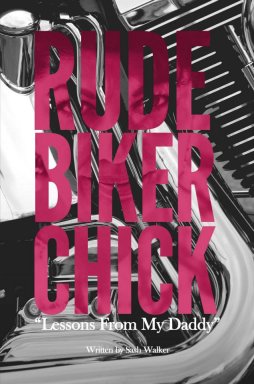 Y’all probably remember (because, come on, who can forget…?) my dear pal Tina “Sash” Walker and her husband, Steve “Highway” Johnson – they came to Iowa on their original Road Pickle journey in 2013 and I had the privilege of taking them around some of my favorite sights and roads. (Hey, the girl wanted to see Iowa CORN – what else could I do?)
Anyways, Tina has her own internet-based marketing/coaching business, numerous blogs, and an open book of a life that sometimes puts her in the hot seat but always keeps her memorable.
Hopefully, you already read her primary blog, Sashmouth, and follow her adventures on Facebook, Twitter, and Instagram. And if you do, you know her no-holds-barred personality. And you might have occasionally wondered just how she came to be – well – herself. In her latest e-book, Rude Biker Chick, you get the good, the bad, the ugly, and the beautiful about what drives this amazing, amusing, unforgettable lady.
Rude Biker Chick: Lessons From My Daddy is just as no-holds-barred as Tina herself. It ruthlessly covers her early life experiences with an abusive mother, a distant father, and a deep connection to traditional biker culture.
But she doesn’t stop there, and believe me the book is not about pointing fingers for “who’s to blame.” Tina goes on to chronicle a disastrous first marriage, a more-than-brush with death itself, and the life-changing days that followed both as she rose from the rubble not to re-invent herself but to become who she really was all along.
Rude Biker Chick isn’t rude at all – although that’s what some people say about Tina. It’s a raw, honest look at how one human being took all the crap from a life that wasn’t hers… and turned it into something beautiful and right. This book is seriously fearless, and seriously worth every moment it takes to read it.
Memorial Day 2015
by Corn Dog on May 24, 2015
in Commentary
May your weekend (and beyond) be filled with gratitude for those who gave all in service to Freedom.

Sharing my journey
by Corn Dog on May 21, 2015
in Commentary
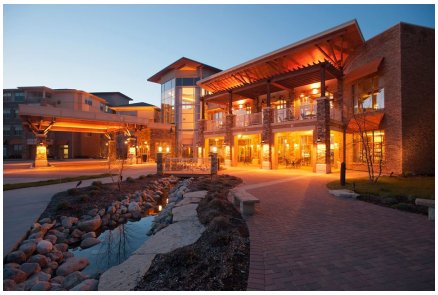
Photo courtesy of Edgewater – A WesleyLife Active Life Community, West Des Moines, Iowa.
‘Round here I write mostly about riding. I hardly ever write about my personal life unless it’s a major milestone or something.
So you probably don’t know that my day-job (which many say I should not quit, despite my best efforts at blogging and karaoke) is that I work as the Lead Concierge at an senior community here in Central Iowa called Edgewater.
That means I manage a customer service team which takes care of the needs and myriad requests of over 200 older adults. The community where I work is not – and I cannot stress this enough – a typical retirement home. It is comprised of beautiful apartments and townhome villas for the independent residents, and smaller but well-appointed suites for the people in other levels of care.
My team takes care primarily of the independent living residents – and I do mean, independent. Heck, almost all of them still drive and some of them even still go to work every day. Most of them volunteer extensively, not only in the building but also out in the central Iowa area. They are active, vibrant, retired professors, farmers, teachers, business professionals, and much more – and they all have fascinating histories to share.
Fortunate was I, then, to learn recently that they just might be interested in learning a little more about my favorite past-time – motorcycling! Our activities director, Dawn, encouraged me to put together a program featuring photos from my many motorcycle rides and talk about my adventures. They’ll love it, she said.
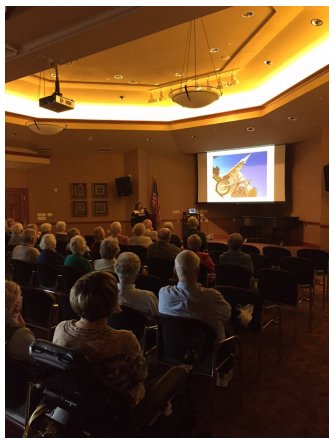
Photo courtesy of Edgewater – A WesleyLife Active Life Community, West Des Moines, Iowa.
So I did! I put together about 60 photos from various rides, organized them loosely into talking points, and then did a 45-minute extemporaneous (and hopefully amusing) talk that emphasized my love for Iowa’s roads, landmarks, history and food. Of course I mentioned our trips to the Sturgis rally, told tales of my (thankfully) few mishaps, and read a brief bit from my e-book, GET ON. But primarily, because my audience loves Iowa as much as I do, I focused on my memorable Iowa rides.
I gave my program on May 19 to a large group of residents, who – I’m glad to say – seemed to enjoy themselves as much as I did. It was a blast – and, a few members of the Merry Band even attended to egg me on!
The comments afterwards were plentiful and positive, with the only complaint being that I didn’t ride the bike into the performance hall. (I wanted to, but I knew if I did this would be the day I would forget to put the kickstand down. Oh, and, it was 39 degrees in the morning when I woke up, and I don’t ride in anything under 50 these days – at least not intentionally.)
There may be opportunities for me to take this show on the (local) road, so I might have gigs soon at a couple other communities. But even if it was a one-time thing, I thoroughly enjoyed sharing my passion for riding with my extended family at Edgewater!